
| |
|
| |
| Links: |

Future Market Insights’ recently compiled report offers prospects of the global molecular biology enzymes, kits & reagents market for the period between 2017 and 2026. The report projects the market to register a splendid growth through 2026. Sales of molecular biology enzymes, kits & reagents worldwide are poised to exceed US$ 21,000 Mn in revenues by 2026-end.
Technological Advancements Leading to Enhanced Efficiency & Greater Precision of Molecular Biology Enzymes, Kits & Reagents
Many technological advancements are been made by the molecular biology enzymes, kits & reagents manufacturers, who dedicate their focus toward developing advanced products in a bid to enhance their product portfolio. The advanced products facilitate the research processes with offerings such as enhanced efficiency and greater precision. One of the greatest examples of this is SMART Digest Kit developed by Thermo Fisher Scientific, Inc., designed particularly for the biopharmaceutical & proteomic applications. This kit enables the generation of data of high quality, meanwhile curtailing time needed for preparation of samples. Adoption of molecular biology enzymes, kits & reagents will further be propelled by huge investments made in the research & development by pharmaceutical & biotechnology industries coupled with the provision of several reimbursements for molecular diagnostics.
A significant increase in the genetic disorders’ prevalence has been witnessed since the recent past, thereby driving adoption of molecular diagnostics. The processes of molecular diagnostics including epigenetics and polymerase chain reaction (PCR) require molecular biology enzymes, kits & reagents as, which form an integral part of these processes. Mounting cases of genetic disorders in light of growing geriatric population will significantly fuel demand for molecular biology enzymes, kits & reagents in the near future. Genetic data of individuals is considered highly confidential, and sharing this data is strictly prohibited. Genome sequencing aids identifying & treating a wide variety of diseases. However, there is lack of tools that are effective for securing the genetic information of individuals, and the information ends up being stored in cloud databases, which further poses threats regarding data thefts. The absence of effective technology to store genetic information is anticipated to negatively influence demand for molecular biology enzymes, kits & reagents.
Request Sample Report @ https://www.futuremarketinsights.com/reports/sample/rep-gb-6385
Key Research Findings from the Report
Although sequencing is expected to prevail as the largest application of molecular biology enzymes, kits & reagents in terms of revenues, synthetic biology is anticipated to persist as the fastest expanding application segment in the market. Cloning application segment will also exhibit an impressive expansion, and will account for the second largest revenue share of the market during the forecast period.
Academic and research institutes are expected to register fastest expansion in the market through 2026, based on end-users. However, revenues from this end-user segment will remain comparatively lower than other end-user segments included in the report.
Revenues from sales of molecular biology enzymes, kits & reagents for use in pharmaceutical and biotechnology companies are expected to account for the largest market share during 2017 to 2026.
Kits & reagents will prevail as top-selling and fast-selling product in the market. Between modifying enzymes and restriction enzymes, the latter will exhibit a relatively faster sales expansion whereas the former will account for a larger market revenue share through 2026.
North America is anticipated to remain the most remunerative market for molecular biology enzymes, kits & reagents, followed by Asia-Pacific excluding Japan (APEJ).
Request to View TOC @ https://www.futuremarketinsights.com/askus/rep-gb-6385
Prominent companies in the global molecular biology enzymes, kits & reagents market are implementing strategies including manufacturing capacity & geographic expansion. Manufacturers are also concentrating on new product launches for enhancing their shares in this increasingly competitive market. The report has listed key players supporting the market growth, which include Thermo Fisher Scientific Inc., Illumina, Inc., Roche Holdings, Inc., Takara Bio Inc., Jena Bioscience GmbH, Merck & Co Company, Qiagen N.V., Agilent Technologies, Inc., KRISHGEN BioSystems, and Promega Corporation.
(Added: Thu Mar 07 2019 Hits: 1 Rating: 0.00 Votes: 0) Rate It
According to the latest research by Future Market Insights (FMI), the tattoo removal lasers market closed in on US$ 179 million in 2018. The revenue growth of tattoo removal lasers market has been estimated at a promising rate over the course of coming years. While over 7 in 10 patients prefer aesthetic clinics for the procedure of tattoo removal lasers, market value share of tattoo studios is likely to expand in coming years, as per FMI’s analysis.
Tattoo removal lasers have been incorporating the latest laser technologies specific to tattoo removal procedures. Constant developments in the tattoo removal lasers landscape, increase in product penetration across different regions, and increasing government support for R&D of innovative tattoo removal lasers will remain key demand determinants in tattoo removal lasers market.
Several new technologies have been contributing to the revenue growth of tattoo removal lasers market. However, picosecond tattoo removal lasers are extremely expensive. A combination of wavelengths has been in high demand for tattoo removal. For instance, according to a research study conducted on five patients by the Laser Health Academy, better clearance was achieved with a combination of 1,550 nm non-ablative fractional laser+YAG laser as compared to other tattoo removal lasers. The combination of YAG+YAG also resulted in shorter recovery time.
According to research studies conducted on tattoo removal lasers, a combination of QS Nd: YAG (1064 nm) and CO2 lasers for tattoo removal also resulted in a significantly high improvement on the combination side for Indian skin. Combination of tattoo removal techniques is being perceived as more effective than only Q-S tattoo removal lasers, as the former reduces the need for multiple sessions.
Request Sample Report @ https://www.futuremarketinsights.com/reports/sample/rep-gb-2013
Moreover, combination tattoo removal lasers have not only reduced the number of sessions required, but also cut costs and reduced adverse effects such as hyper-pigmentation, long-going inflammatory responses, and bulla formation. Extensive research on the efficacy of these combination tattoo removal lasers are warranted, specifically considering the high patient demand for tattoo clearance. Thus, the high demand for combination tattoo removal lasers has consistently driven the tattoo removal lasers market.
However, tattoo removal lasers work differently on different skin types, which may involve multiple adverse effects. Tattoo removal lasers that involve Q-switched also require eye protection for the prevention of retinal damage. Q-switched ruby tattoo removal lasers are linked with high clearance rates but are also contradictory because of the high incidence of prolonged hypopigmentation. Such adverse effects of tattoo removal lasers will remain are expected to hamper the growth of the tattoo removal lasers market during the forecast period.
The tattoo removal lasers market report tracks some of the key companies operating in the tattoo removal lasers market, which include Hologic Inc. (Cynosure), Shanghai Fosun Pharmaceutical(Group)Co., Ltd. (Alma Lasers), Cutera, Syneron® Medical Ltd., Fotona d.o.o., LUTRONIC, Lumenis, El.En. S.p.A. (Asclepion Laser Technologies GmbH), and Lynton Lasers.
Request to View TOC @ https://www.futuremarketinsights.com/askus/rep-gb-2013
Some of the commonplace complications that result post tattoo removal lasers treatment include prolonged erythema, hyperpigmentation, hypertrophic scar formation, and disseminated infection. On the other side, complications associated with fractional lasers include transient pigmentary changes, mild fibrosis, and hypopigmentation. Though most of the adverse effects associated with tattoo removal lasers can be cured within a short span of time, some of them may lead to serious complications in terms of skin texture and pigmentation.
(Added: Thu Mar 07 2019 Hits: 1 Rating: 0.00 Votes: 0) Rate It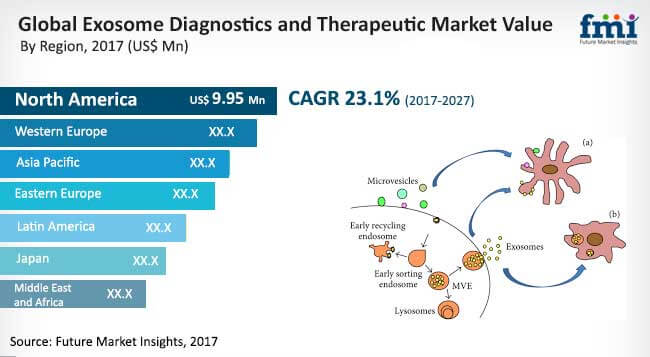
Future Market Insights in its recent research report titled “Exosome Diagnostic and Therapeutics Market: Global Industry Analysis (2012-2016) and Opportunity Assessment (2017-2027)” covers several factors that are influencing the robust growth of the global market. As per this research report, the global exosome diagnostic and therapeutic market is projected to expand at a high CAGR of 23.1% during the period of assessment. The exhaustive research publication includes key trends, opportunities, threats, growth drivers and challenges that impact the global exosome diagnostic and therapeutics market. Detailed pricing analysis of different exosome diagnostic and therapeutics across key regions is also discussed in the research study. The segmental analysis across North America, Western Europe, Eastern Europe, Asia Pacific excluding Japan (APEJ), Latin America, Japan and Middle East and Africa (MEA) is carried out which is used to track the future projections for a period of ten years, pertaining to value, of the global exosome diagnostic and therapeutics market.
Global Market for Exosome Diagnostic and Therapeutics: Underlying Forces Influencing Growth
The growth of global market for exosome diagnostics and therapeutics is influenced by several factors. Increasing need for screening and diagnosis of chronic diseases coupled with high therapeutic potential of exosomes are fuelling the adoption of exosome diagnostics and therapeutics. Moreover, introduction of explicit systems for analysis of proteins specific to exosomes, increasing research and development activities supported by favourable government policies across various regions and increasing popularity of exosome over CTC and ctDNA are expected to trigger the growth of the global market for exosome diagnostic and therapeutics market in the years to follow. On the contrary, lack of standardization and validation requirements for isolation of exosomes is expected to pose hindrances to the growth of the global market. Other factors negatively impacting the market’s growth include heavy investments in research and development and insufficient insurance coverage of costly cancer diagnostic tests.
Request Sample Report @ https://www.futuremarketinsights.com/reports/sample/rep-gb-6379
Segmentation Highlights of the Global Exosome Diagnostic and Therapeutics Market
The global exosome diagnostic and therapeutics market is segmented on the basis of product type, application, end user and region.
In the region category, North America is estimated to be the largest with a high market lucrativeness. This region is expected to grow at a significant CAGR during the forecast period to touch a large market estimation by end of the assessment year, thus leading the global market. Moreover, Asia Pacific excluding Japan (APEJ) is the fastest growing region and is the second largest in terms of adoption and use of exosome diagnostics and therapeutics. APEJ is filled with high growth opportunities and is being targeted by several giants in this sector, such as Thermo Fisher Scientific.
By product type, reagents and kits are gaining high traction owing to increasing use in exosome diagnostics and therapeutics. The reagents and kits segment dominated the market in 2017 and is anticipated to continue with the trend in the coming years. This segment is also expected to expand at a high growth rate during the forecast period. The reagents and kits segment is expected to register a high CAGR of 28.2% throughout the period of forecast. The software segment is the second fastest growing segment spurring the growth of the global market.
In the application category, diagnostic segment is the largest as compared to therapeutics segment and is estimated to touch a value of over US$ 90 Mn by the end of the year of assessment, growing at a significant pace. Therapeutics segment is projected to expand at a CAGR of 29.0% throughout the period of assessment.
With respect to end user, the use of exosome diagnostic and therapeutics is largely observed in diagnostic centres. The diagnostic centres segment is expected to surpass other end user segments with a high market share and growth rate in the coming years.
Forecast Analysis of the Global Exosome Diagnostic and Therapeutics Market
According to the research report, the global market for exosome diagnostic and therapeutics is expected to grow at a high CAGR to reach an estimate of over US$ 150 Mn by the end of the year of assessment from a value of about US$ 19 Mn in 2017.
Request to View TOC @ https://www.futuremarketinsights.com/askus/rep-gb-6379
Competitive Landscape Shaping the Global Exosome Diagnostic and Therapeutics Market
Manufacturers of exosome diagnostic and therapeutics are focusing to raise capital required for launch of new products or research and development expenses through venture financing. Key companies such as Thermo Fisher Scientific, Inc., NanoSomix, Inc., NX PHARMAGEN, Capricor Therapeutics, Inc., Exosome Diagnostics, Inc., Exiqon A/S (Aethlon Medical, Inc.)., System Biosciences, Inc., Aegle Therapeutics AMS Biotechnology (Europe) Limited and Miltenyi Biotec.
(Added: Wed Mar 06 2019 Hits: 2 Rating: 0.00 Votes: 0) Rate ItPages: [<<] ... 219 220 221 222 223 224 225 226 227 228 229 230 231 232 233 ... [>>]
Links SQL By: Gossamer Threads Inc.