
| |
|
| |
| Links: |

Prominently operated by Colgate-Palmolive Company, Glaxo Smith Kline plc, Johnson & Johnson, P&G, Unilever plc, and Dentsply Sirona, the dental hygiene devices landscape is currently witnessing dominance of toothbrush sales. In recent years, the dramatic growth of the E-commerce sector is translating into elevating online sales of dental hygiene devices, which is posing strong competition facing the retail pharmacy segment.
A recent market research study by Future Market Insights provides exclusive insights on the current and prospective performance of global dental hygiene devices market, in terms of sales volume as well as revenue.
“The report categorizes dental hygiene devices landscape into the toothbrush, scalers, polishing devices, and others on the basis of product type. Toothbrush has been the top-selling product in global dental hygiene devices landscape, attributed to widespread availability, extensive selection range, broad price range, and frequent innovation,” explains a senior research analyst at FMI.
Currently, toothbrush sales account for almost 60% of the total market revenue, whereas the report indicates that dental scalers and dental polishing devices are gradually gaining ground. The study projects over 5% year over year revenue growth for the latter two in 2019 and ahead.
Retail pharmacies will remain the largest revenue generating channel of distribution in dental hygiene devices market. Whereas, online pharmacies are slated to present promising investment opportunities to dental hygiene devices manufacturers. The report projects that revenue generated through online retail would cross the US$ 1 billion mark in the next 3-4 years.
Request Sample Report @ https://www.futuremarketinsights.com/reports/sample/rep-gb-8177
The global dental hygiene devices market is low-value high-volume landscape, which remains the key factor that dampens investment. While baby boomers have been referred to as the primary consumers of dental hygiene devices, a growing percentage of juvenile and millennial people afflicted with one or more oral health problems points to the widening prospects of dental hygiene devices in coming years.
Increasing dental disease prevalence, coupled with the increasingly sophisticating infrastructure of dental care across developing regions, is predominantly responsible for improving the scope of dental hygiene devices penetration. Dental caries, periodontal conditions, and oral cancer mark some of the most significant concerns related to oral healthcare, among the population.
“OTC (over-the-counter) nature of a majority of dental hygiene devices remains one of the key factors positively influencing their widespread availability and sales,” says the FMI analyst.
Adding further to it on the potential market growth barriers, the analyst says, “As dental disorders are often non-life threatening, a notable portion of the patient population tends to initially prefer alternative treatments over dental hygiene devices. Price pressure and poor RoI are identified to be longstanding challenges for manufacturers of dental hygiene devices to initiate large scale investment projects”.

The report sheds light on all the aspects related to worldwide demand for dental hygiene devices and offers insights on the growth prospects projected for global dental hygiene devices market through the next few years. The report forecasts steady yet moderate yearly revenue growth of 4.7% in 2019, and around 1/3rd of the total market value is poised to be accounted for by the Asia Pacific. North America and Western Europe are likely to hold a collective share of more than a third of the global market value.
APAC and Latin America are poised to remain highly lucrative regional markets for manufacturers of dental hygiene devices owing to consistently increasing demand for dental treatments in these regions.
Although the widening patient pool is driving the steady demand for dental hygiene devices, a sizeable population based in developing countries is still undiagnosed and untreated. FMI research points to the presence of several untapped opportunities in a massive untreated population and thereby highlights high attractiveness of emerging regional markets for dental hygiene devices manufacturers.
Besides frequent product innovations, key players in the global dental hygiene devices market maintain their strategic focus on the enhancement of distribution channel by strengthening existing marketing efforts across Asian markets, particularly in India, Singapore, and Malaysia.
Request to View Methodology @ https://www.futuremarketinsights.com/askus/rep-gb-8177
Toothpaste Innovations Account for a Trending Wave
The report suggests that strategic collaborations, new product launches, and geographical expansion remain the highlights of developmental strategies adopted by key companies operating in dental hygiene devices landscape. Electric/battery-operated toothbrush innovations continue to shape new launch strategies of a majority of companies, whereas most of the market leaders are focusing on introducing novel toothpaste ranges specific to various oral care demands.
GSK recently unveiled a range of Aquafresh Advance specifically for 9-12 years olds' demographic, targeting enamel protection and cavity prevention. The company's Consumer Healthcare arm also launched a new Sensodyne Rapid Relief range in the US.
P&G also released a new toothpaste range recently, specifically for improved gum health.
Dabur India Ltd. launched a modern variant of their flagship toothpaste range i.e. ayurvedic specialist toothpaste in gel format.
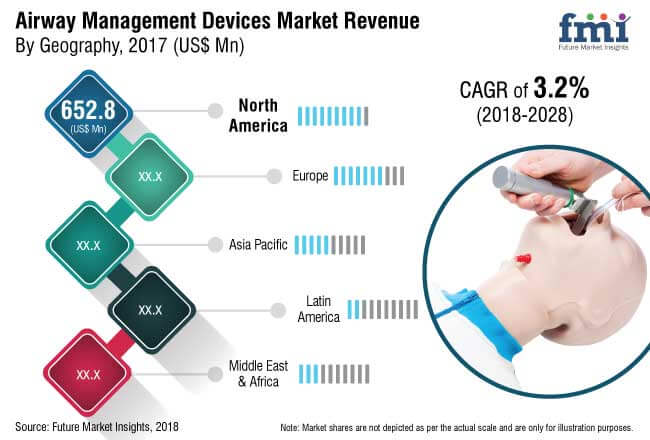
The approximately US$ 1.3 billion market for airway management devices is likely to observe a sluggish pace over next few years, presumably crossing the revenue of US$ 1.5 Bn towards 2022 end. Around half of the market value share is accounted by North America, according to the report.
A senior research analyst at the company says, "The well-known complications and contraindications associated with the use of airway management devices continue to restrict adoption of airway management device types. The subsequent safety concerns are thus leading to frequent product recalls, resulting in the limited growth potential of airway management device landscape at a global level".
Explaining the market dynamics further, the analyst says, "The companies are however extending strong efforts towards adapting their products to evolving regulatory guidelines and thereby boosting new product launches. While preventing product recalls will remain in the focal point for manufacturers of airway management devices, they continue to primarily witness sustained demand for anesthesia administration".
Request Sample Report @ https://www.futuremarketinsights.com/reports/sample/rep-gb-7775
Pre-hospital Settings Are Increasingly Demanding ‘Safer’ Single Use Airway Management Devices
With decently growing demand for emergency medical services and trauma management, the pre-hospital airway management is constantly becoming an imperative segment. With a primary objective to prevent the risks of cross infection, pre-medical settings are generating consistently growing demand for disposable laryngeal masks. While these airway management devices allow easy insertion and curtail the chances of gastric aspiration, it is more likely that single use airway management devices will witness steady revenue growth in coming years.
FMI Highlights Opportunities for Pediatric Airway Management Devices Manufacturers
In an effort to facilitate the otherwise challenging pediatric airway management, manufacturing companies leading the airway management devices landscape are incorporating an extensive range of cutting-edge technologies in existing devices. The FMI report indicates a chunk of lucrative opportunities residing in the pediatric airway management segment.
The Classic Laryngeal Mask Airway (LMA) is currently witnessing notable traction owing to its exceptional efficiency in terms of attaining ventilation in children.
The Proseal LMA is likely to enjoy notable adoption in coming years.
Recently, Smith Medical launched Protex Bivona FlexTend TTS tracheostomy tubes exclusively for newborns, further covering pediatric patients in the company’s flagship product line.
The FMI analyst also says, “While the airway management space has been witnessing the successful introduction of next-generation endo-bronchial tubes equipped with camera, there is a strong likelihood of fostered product demand for thoracoscopic lung surgeries as well as in robotic surgeries. This and more such technological innovations can potentially uplift the revenue growth scenario of airway management devices market in coming years”.
Segmentation Analysis by FMI at a Glance
EndoBronchial tubes hold over 40% share of the current market value, followed by laryngeal masks, reveals the airway management devices market analysis by the type of product. Nasal airway tubes are projected for a relatively positive revenue growth outlook in the near future.
Based on the type of usage, single use or disposable airway management devices continue to command over the major market revenue, in contrary to the reusable airway management devices.
While hospitals are identified to be accounting for over 45% market revenue share according to the end user analysis, ambulatory surgical centers also hold a sizable share of the total market value.
With more than half of the total market value attained through estimated sales of airway management devices, North America continues to govern the global landscape, led by the US reportedly contributing more than US$ 840 Mn to the market in 2019.
Western Europe and Asia Pacific are projected to position themselves as the next important regional markets for airway management devices.
Companies Extend Concerted Efforts on Introducing New ‘Readily Approved’ Products
New product launches currently atop the strategic minds of global leaders in the airway management devices landscape. The key focus area however is to abide by the regulatory standards and achieve approvals in the first go.
Teleflex Incorporated recently announced the launch of LMA Gastro Airway that is a Cuff Pilot Technology-enabled laryngeal mask. While this is the first-ever laryngeal mask that allows facilitated esophageal access, it also promotes the airway control during a range of endoscopic procedures.
Request to View Methodology @ https://www.futuremarketinsights.com/askus/rep-gb-7775
M&A Remains a Favored Strategy for an Edge over Competition
Strategic mergers and acquisitions will also remain an important generator of expansion opportunities for leading players in airway management devices market.
Partial acquisition of Airway Medix S.A. by Teleflex Incorporated that completed in the H2 last year had enabled the former to introduce CSS technology-enabled airway management. This advanced technology product innovation has been the company’s important engine for regional market penetration.
pop (Added: Wed Mar 13 2019 Hits: 99 Rating: 0.00 Votes: 0) Rate ItPages: [<<] ... 214 215 216 217 218 219 220 221 222 223 224 225 226 227 228 ... [>>]
Links SQL By: Gossamer Threads Inc.