
| |
|
| |
| Links: |
~78.0% Revenue Contribution by Leading Manufacturers in the 3D Cell Culture Market
The 3D cell culture market is largely dominated by major key players such as Thermo Fisher Scientific Inc., Merck KGaA, Becton, Dickinson and Company, and Lonza, Corning Incorporated, and Synthecon, Inc. that serve various types of 3D cell culture products. The key manufacturers of 3D cell culture are focusing on research and developmental activities and they are also trying to focus on the clinical trial outcomes. Many companies are actively involved in acquisitions to introduce new innovative products in the market.
Increasing Focus on Oncology Drug Research
The awareness regarding oncological diseases is increasing among the population, which is expected to increase the growth of the 3D cell culture market. Cell culture is an important part of Oncology as it is involved in the clinical trials and also plays an important role to understand the morphology and physiology of the cells in a given environment. Cell-based culture is also used in drug development as it helps to understand various cellular pathways. Cancer research depends on cell-based assays comprising of in-vitro cell culture. Financial support for cancer research by governmental and non-governmental organizations is growing, resulting in significant growth of the 3D cell culture market.
Enhanced Resemblance to In-Vivo Environment
3D cell culture creates an artificial environment for the growth of the cells to study their behavior in response to the given environment. 3D cell culture is highly used for its convenience and innovative features as compared to other cell culture methods, which drive the 3D cell culture market.
3D cell culture represents a clear picture of the cell’s morphology. 3D cell culture is involved in a better representation of cell differentiation and proliferation. As compared to 2D cell culture, 3D cell culture gives a clear picture of the tissue organization. The efficiency of 3D cell cultures closely mimics the natural environment for culturing of cells and generate more accurate models of tissues is considered to be a driver of the 3D cell culture market.
Request Sample Report @ https://www.futuremarketinsights.com/reports/sample/rep-gb-2843
Cost-effective Drug Discovery
According to the European trade association, the research investment for drug discovery has grown by 5.2 times in the U.S. and 3.3 in Europe from 1990 to 2003.
The traditional methods of drug discovery are inadequate and less relevant to the pace of the growing life science research and development. 3D cell cultures are, therefore, expected to generate a major revenue share in the market for drug discovery application.
Rising Demand for Regenerative Medicine
Personalized medicine deals with the information of the patient and their genetic make-up. Personalized medicine makes better treatment options and therapies leading to better patient outcomes. It also predicts the treatment response of the patient before undergoing therapy or treatment.
3D cell cultures are mainly used to observe the cell interactions and the abnormal behavior of cells and play a major role in the development of personalized medicine.
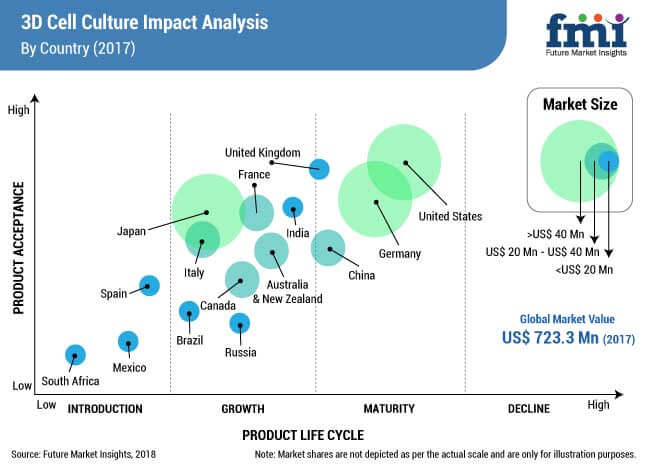
Competitive Landscape of the Global 3D Cell Culture Market
The competition section of the 3D cell culture market represents the profiles of the key players operating in the 3D cell culture market based on the products they offer and the total revenue of the companies. Some of the key players featured in this report include Thermo Fisher Scientific Inc., Merck KGaA, Becton, Dickinson and Company, Lonza, and Corning Incorporated.
The key manufacturers of 3D cell culture offer a wide range of products. Thermo Fisher Scientific, Inc. has developed a joint platform for advancing research in precision medicine.
Corning, one of the major leaders in 3D cell culture market, manufactures cell culture products, which include consumables (such as plastic vessels, specialty surfaces, cell culture media, and serum), as well as general labware and equipment, which are used for advanced cell culture research.
Request to View Methodology @ https://www.futuremarketinsights.com/askus/rep-gb-2843
Definition
3D cell culture creates an artificial environment for the growth of the cells to study their behavior in response to the given environment. 3D cell culture can be defined as the culture of living cells which forms a three-dimensional structure and mimics a tissue or an organ. 3D cell culture is highly used for its convenience and innovative features as compared to other cell culture methods.
3D cell culture can be scaffold-free or scaffold-based 3D cell culture. Scaffolds are responsible for providing support to the cells.
(Added: Tue Jun 18 2019 Hits: 1 Rating: 0.00 Votes: 0) Rate ItA particle counter is an instrument used for monitoring the indoor air quality in workplaces and clean rooms as it determines the concentration of particles in the air. Various factors are impacting the overall growth of the market. Another key factor driving the growth of the particle counter market is the increasing usage of particle counters in the healthcare and pharmaceutical industry. Particles in pharmaceutical fluids are counted in compliance with pharmaceutical standards.
Apart from the above-mentioned factors, there are few factors that are likely to hamper the overall growth of the particle counter market. For instance, the high costs associated with benchtop particle counters and the high maintenance cost associated with portable and handheld particle counters are among the major factors that are estimated to hinder the growth of the particle counter market.
Oil & Gas industry Generating High Demand for Liquid Particle Counters
In the oil & gas industry, particle counters are used for the hygiene control of liquid-based hydraulic solutions as well as for the examination of the contamination of injected water. Moreover, liquid particle counters are used in the aerospace industry to determine kerosene compliance with the DEF STAN 91-91 and IP 577 standards or barely inflammable hydraulic fluids. Thus, the increasing demand for the liquid particle counters in the field of waste water and process water to determine the quality of water, as well as the increasing demand for the detection of the particle sizes in water treatment plants are also among factors boosting the particle counter market.
Request Sample Report @ https://www.futuremarketinsights.com/reports/sample/REP-GB-9466
Based on regions, North America is expected to hold the prominent share of the particle counter market due to the increasing presence of the pharmaceutical sector. In the Middle East and Africa, there is increasing demand for liquid particle counters in the oil & gas industry. These are some of the factors are propelling the growth of the particle counter market. North America is estimated to be a prominent region in the global particle counter market because of presence of a well-developed pharmaceutical and healthcare sector and numerous technological improvements in the region. The increasing spending on healthcare and pharmaceuticals is also responsible for boosting the growth of the particle counter market in North America.
Tier 1 Players Account for around 45% Global Market Revenues
The report tracks some of the key companies operating in the market, such as Lighthouse Worldwide Solutions, Airy Technology, PAMAS, RION Co., Ltd, Climet Instruments Company, Chemtrac Systems, Inc., Hach, Met One Instruments Inc., Cole Parmer, Zinter Handling Inc., Fluke Corporation, FLIR, and Kanomax. There are several other companies operating in the particle counter market. Beckman Coulter, PCE Instruments, TSI Inc., and Spectris Company are estimated to capture a prominent share of the particle counter market. These tier 1 companies hold a share of approximately 45% of the particle counter market.
Request to View Methodology @ https://www.futuremarketinsights.com/askus/rep-gb-9466
Some of the prominent vendors are primarily focusing on inventing and introducing new and advanced products. Prominent vendors in the market are focusing on acquisitions and collaborations. For example, in February 2019, Beckman Coulter, one of the prominent manufacturers of particle counters, entered into a liquid biopsy partnership with Apostle Inc. the Apostle Inc. is a liquid biopsy company. Beckman Coulter entered in partnership for increasing the product portfolio of the company and to improve the product portfolio. In addition, in January 2019, the Beckman Coulter Life Sciences acquired Labcyte to expand its laboratory automation business.
(Added: Mon Jun 17 2019 Hits: 3 Rating: 0.00 Votes: 0) Rate It
An Ammeter is a device which is used to measure the current in the circuit. Ammeters are used to take readings of the flowing currents in the circuit, in addition to measure the flow of current through the electric wiring. These devices are commonly used by electrical devices manufacturers on daily basis to ensure the proper functioning of the electrical instruments. The use of this current measuring instruments is vast, ranging from construction buildings to laboratories. Increasing use of ammeters to ensure safety and proper functioning of electric devices is propelling the demand in the market. Based on the measurement type, ammeters measure the level of AC and DC current.
New advanced and upgraded digital ammeters with innovative features such as adjustable sampling rate, alarm LED, internal data storage, embedded filters, and overload protection makes current measuring process easier which ultimately boosts the market globally. Electrical industry growing at rapid pace and increasing demand for this instrument in electrical industry is boosting the growth of ammeters market. They are frequently used in the automobile industry to check and measure the current flowing from the battery. Manufacturing of modern cars with higher automation is ultimately fuelling the growth of the ammeters market.
Request Sample Report @ https://www.futuremarketinsights.com/reports/sample/rep-gb-9437
Ammeters Market: Drivers and Restraints
Frequent Use of Ammeters in Construction and Electrical Industry Favoring Revenue Growth of Market
Construction industry is one of the rapidly growing industry all across the globe. Installation of electrical wiring and instruments in newly constructed buildings is mandatory. Ammeters are used to measure the level of current in the electrical wirings of newly constructed buildings to ensure that the current is not too high or not too low. Electricians often use it to detect and correct the circuit faults in the building.
Rapid adoption of advanced ammeters in the construction industry to maintain the safety of electrical wiring and instrument is driving the market significantly. Safety norms and regulations associated with the electrical instrument installation is also affecting the demand of the ammeters considerably. Electrical instrument manufacturers are more focusing on providing quality and reliable electrical instruments to the customers.
Manufacturers also frequently use ammeters to ensure the proper functioning of electrical devices before launching them into the market. Changing approach of the manufacturers towards providing quality electrical devices is boosting the ammeters market globally.
Ammeters Market: Segmentation
On the basis of measurement type, ammeters market is segmented into
On the basis of product type, ammeters market segmented into
On the basis of end use, ammeters market segmented into
Ammeters Market: Competition Landscape
Key manufacturers of ammeters are Electrical Test Instruments, LLC, Federal Elektrik, Crompton Instruments, HT Italia, Celsa Messgeräte GmbH, CIRCUTOR, and Autonics.
Ammeters market is highly fragmented with large number of local players along with global key manufacturers. Presence of adequate amount of small players in the market with key manufacturers is ultimately creating higher competition. Due to the scenario of higher competition, prominent manufacturers are concentrating on designing advanced ammeters to attract a significant portion of the customers. Manufacturers are using E-commerce websites at a great extent to provide ammeters globally in lesser time.
Request to View TOC @ https://www.futuremarketinsights.com/toc/rep-gb-9437
Ammeters Market: Regional Overview
Technological advancement in electrical industry, especially in testing equipment domain in North America region is driving the ammeters market in terms of revenue. Growing Construction industry in this region is ultimately promoting the demand considerably. High adoption of these advanced devices in countries such as UK and Germany propels the growth of the ammeters market.
Enlarging automobile and construction industry in APEJ region is also contributing to the growth of ammeters market. Owing to increasing automobile manufacturing plants in the MEA region in recent years is one of the factors that accelerating the demand of ammeters in the market.
(Added: Fri Jun 14 2019 Hits: 1 Rating: 0.00 Votes: 0) Rate ItThe approximately US$ 634 million market for diaper rash cream is likely to demonstrate strong growth potential during forthcoming years. According to a recent research study of Future Market Insights (FMI), the global sales of diaper rash cream will see a healthy 6.7% increase in 2019, prominently driven by the ‘infants’ segment. More than 3/4th of overall demand for diaper rash cream is accounted by the infant care segment, says FMI in the report.
Over 70% of the sales of diaper rash cream is accounted by the household applications, followed by that at hospitals and clinics. However, FMI's analysis points to the promising growth outlook for diaper rash cream market in the day care centers, over the years to come. Following drug stores and pharmacies, supermarkets and hypermarkets are also developing as the key sales channels of diaper rash cream. The combined share of both the segments has been envisaged to be over half of the total market value, estimated for 2019.
The “Free-from” Trend Is Invading Diaper Rash Cream Market
According to expert pediatric dermatologists, more than half of babies suffer from diaper rash at some point of time. While this remains the key factor underpinning demand for diaper rash cream, the over-the-counter availability also make diaper rash cream an increasingly selling product in the personal care space, particularly in the skin care industry.
Request Sample Report @ https://www.futuremarketinsights.com/reports/sample/rep-gb-8097
Adults who have to use diapers, and parents of infants and toddlers, are increasingly inclined toward diaper rash cream and related products that exclusively contain natural and organic active ingredients. The trend of free-from synthetic compounds and fragrances, paraben-free compounds, and other safe ingredients is mushrooming across the personal care industry, thereby pushing the sales of organic diaper rash cream further. According to FMI’s report, more than 65% of total diaper rash cream consumed, contains organic compounds as key ingredients.
Key Manufacturing Players Are Focused on “Low/No Synthetic Ingredients”
It has been observed that some of the key manufactures of diaper rash cream are engaged in developing formulations based on plant-based and herbal sources, which potentially comprise of low or no synthetic ingredients. They will be focused on the entire allergen list, including silicones, parabens, and phthalates among others. Use of petroleum and zinc oxide as an effective barrier to moisture creation inside diapers will remain one of the key strategies among competitors actively partaking in the diaper rash cream industry’s landscape. However, regulation of the percentage of such compounds to prevent potential adverse effect on skin will be a longstanding concern facing manufacturing companies.

Moreover, clinically and dermatologically tested and certified diaper rash cream products launched by companies, will experience soaring traction in the near future, suggests the report. Top brands in the baby care products landscape are also likely to strategize on brand exposure, aggressive marketing, and increased outreach to multiple sales channels, to beat the intense competition.
The report further highlights that more consumer proclivity for organic, plant-based extracts as key active ingredients will translate into rapid consumption of compounds such as jojoba and other essential oils, and honeysuckle, by R&D units of the companies, manufacturing diaper rash cream and related products.
Request to View TOC @ https://www.futuremarketinsights.com/askus/rep-gb-8097
Currently, the limitation of downstream market is among the most challenging factors hampering diaper rash cream market growth. While companies are capitalizing on the consistently increasing birth rates in developing economies, on the flipside, developed regional markets are highly likely to face a plunge owing to considerably falling rate of births.
Some of the key participants profiled in the global diaper rash cream market report include Bayer AG, Unilever, Chicco USA, Tubby Todd Inc., Beiersdorf Inc., Sebapharma, The Himalaya Drug company, Babo Botanicals LLC, Johnson & Johnson, The Honest Company, Inc., Summer Laboratories, The Natural Baby Company, LLC, Prestige Consumer Healthcare, Inc., Dani Kenney Co., Earth Mama Organics Company, and Weleda Company.
(Added: Thu Jun 13 2019 Hits: 0 Rating: 0.00 Votes: 0) Rate ItPages: [<<] ... 146 147 148 149 150 151 152 153 154 155 156 157 158 159 160 ... [>>]
Links SQL By: Gossamer Threads Inc.